Spirometry
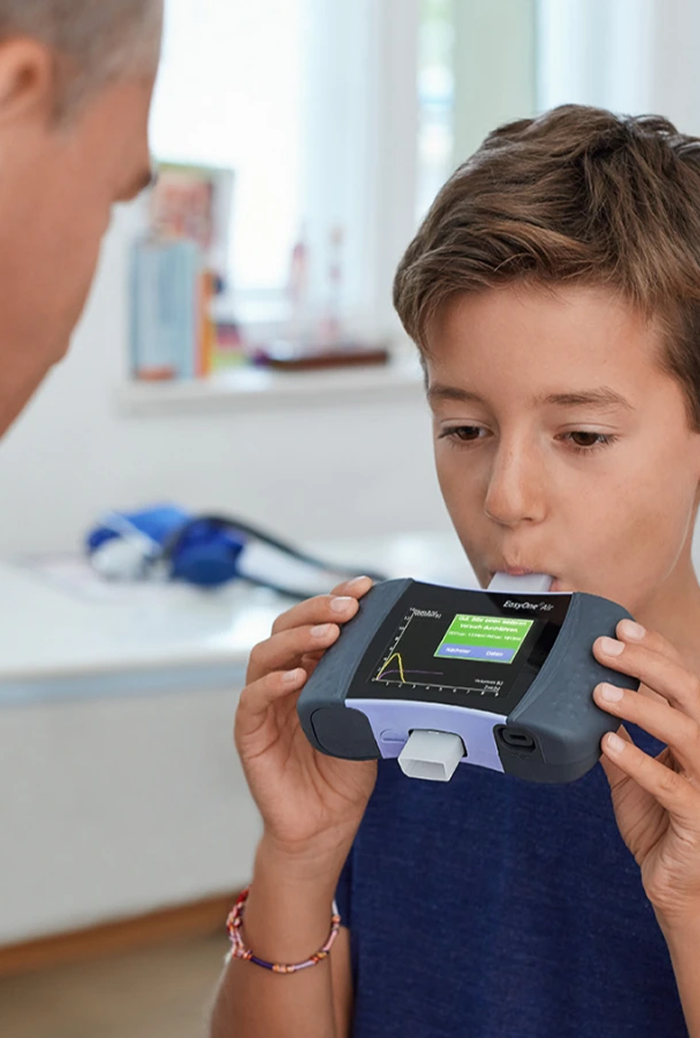
A breathing test that measures how well your lungs are working. You'll take a deep breath and blow into a mouthpiece giving us valuable information about your lung health and helping us diagnose conditions such as asthma.
Asthma, hay fever and eczema are closely connected. Many people with hay fever or eczema may sometimes have airway narrowing without their knowledge. Spirometry helps us understand whether your allergies might be affecting your lung function, which can change how we approach your treatment.
It is certainly possible. Symptoms like a persistent cough, chest tightness, wheezing, or shortness of breath can sometimes point to asthma, especially when they happen alongside hay fever symptoms. Spirometry gives us an objective measurement of whether your airways are narrowed, rather than relying on symptoms alone. Current international guidelines recommend spirometry with a bronchodilator reversibility test as a key step in confirming an asthma diagnosis (2).
Whilst sitting upright you take a deep breath in, then blow out as hard and as fast as you can for several seconds into the spirometry machine. We repeat this a few times to make sure the readings are consistent. Then we will give you a puffer and repeat the test roughly 15 minutes later to see if your airways open up. This before and after comparison helps us identify if you might have asthma (1). The test usually takes around 30 minutes.
Yes. Most children who are six years or older can perform spirometry, as long as they can follow the instructions to blow hard into the mouthpiece. We take extra time to coach younger patients through it.
You may be asked to avoid using your inhaler or certain medications for a set period before the test. Avoid heavy meals and vigorous exercise beforehand, and wear loose, comfortable clothing. Contact our clinic to check for specific instructions.
If your spirometry results show you have narrowed airways, your doctor will give you specific advice on how to manage your condition. Treatment is personalised to each individual and may be adjusted over time based on repeat spirometry testing to monitor your response (3).
1. Spirometry and Bronchodilator Test. Korean Journal of Family Medicine, 2016. Available at: https://pmc.ncbi.nlm.nih.gov/articles/PMC5392482\
2. Global Initiative for Asthma (GINA). Global Strategy for Asthma Management and Prevention, 2024. Available at: https://ginasthma.org/reports/
3. Use of Symptoms Scores, Spirometry, and Other Pulmonary Function Testing for Asthma Monitoring. Frontiers in Pediatrics, 2019. Available at: https://pmc.ncbi.nlm.nih.gov/articles/PMC6413670/